Tasking Tails | 501(c)(3) Nonprofit
Train With Us
Learn about our virtual lessons, memberships, and courses. Have a question? Click the Contact Us button.
Virtual Lessons
We'll meet online (VIA Google Meet) for online training. During our virtual lessons, we'll be answering questions, demonstrating with our own service dogs, troubleshooting issues, sending online resources, and supporting you with everything that involves service dog training.
Virtual lessons are $100 per lesson. Packages are available Financing is available through Affirm.
Free Phone Call
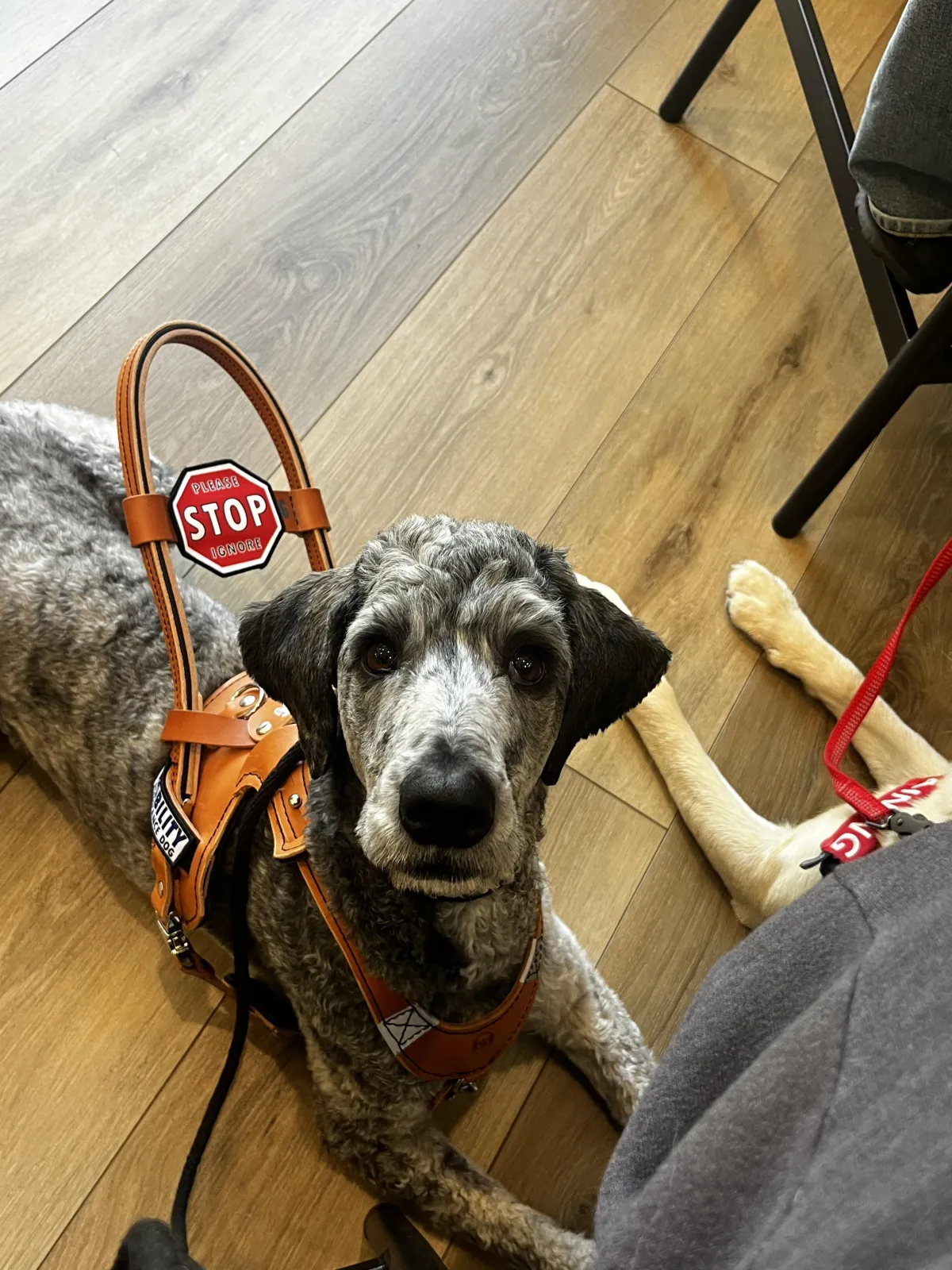
Not sure where to start or what your next steps should be? That's okay! Schedule a free phone call with Kaiden.
We'll talk through your goals, answer your questions, and help you figure out the best path forward for you.
Courses
View our available courses. We have a free mini course that we suggest you start with.
Stuff you’re probably wondering
What is a service dog?
Under the Americans with Disabilities Act (ADA), a service dog is "a dog that has been individually trained to do work or perform tasks for an individual with a disability. The task(s) performed by the dog must be directly related to the person's disability."
Service dogs can assist people with physical, psychiatric, and other disabilities by performing specific trained tasks such as guiding, medical alerting, mobility assistance, allergen alert, interrupting harmful behaviors, or retrieving items. Dogs whose sole function is to provide comfort, companionship, or emotional support do not meet the ADA's definition of a service dog.
Can my dog be a service dog?
Maybe. A service dog does not need to be a specific breed, size, or age, but they do need the right temperament, health, training, and compatibility with their handles tasks and needs.
Good prospects are healthy, confident, friendly, under 3 years old, able to recover from stress, loves training, physically capable of the tasks they may need to perform, and able to remain focused and silent around people, dogs, food, noise, and other distractions.
Dogs with aggression, significant anxiety, reactivity, hyperactivity, or health issues aren't suited for service work, even if they are loving pets or already know helpful tasks.
We look at the dog in front of us, the handler’s needs, the tasks required, and the environments the team will need to navigate before deciding if your dog is a service dog prospect!
How do I know if a service dog is right for me?
That's one of the most common questions we get, and the answer isn't always straightforward.
Not every dog is suited for service work, and not every person who could benefit from a service dog should pursue one.
That's why we created a free course to help you decide. We'll walk you through whether a service dog is the right fit for your lifestyle and disability, how to evaluate whether your current dog has the right temperament, and, if you're still looking, what to look for in a service dog prospect. Our goal is to help you make an informed decision before investing months or years into training.
Go to our Train With Us page to sign up for the free course.
I want to join. How do I get started?
Visit our Train With Us page to explore your options, including virtual private lessons, online courses, and memberships, and see what might be the best fit for you and your dog.
Not sure where to start? Feel free to contact us! We're happy to answer your questions, talk through your options, and help you feel confident about your next steps.
What training methods do you use?
We use a relationship based, game focused approach to training, guided by LIMA (Least Intrusive, Minimally Aversive) principles.
Our priority is teaching dogs what we want them to do, making those behaviors worthwhile, and building clear communication between dogs and their handlers. We use positive reinforcement, practical training games, and gradual exposure to help dogs develop reliable skills they can use in everyday life.
We also believe in accountability, but that doesn't mean jumping straight to corrections when a dog makes a mistake. We first look at whether the dog understands the behavior, has the skills to perform it in that environment, and is physically and emotionally capable of meeting the expectation.
LIMA means choosing the least intrusive, minimally aversive methods that are likely to be effective. It prioritizes the dog's physical and emotional well being, reinforcement based teaching, and addressing the underlying causes of behavior rather than simply suppressing unwanted behaviors.
Our goal isn't just a dog that listens. It's a dog that understands what's being asked, feels confident doing it, and has a strong working relationship with their handler.
I don't have a dog that can be a service dog. Can you help me find one?
Yes. We can help you figure out what type of dog may be a good fit, what traits to look for, and how to evaluate breeders, rescues, puppies, or adult dogs. We have lots of connections with breeders around America as well.
There is no perfect breed or guaranteed prospect, but choosing carefully can make service dog training much more realistic and so much easier. We can help you look at temperament, health, size, task needs, lifestyle, and the environments the dog will need to work in.
We can also help you review a specific dog or litter before you make a decision.
Are you certified dog trainers?
Yes! Tasking Tails was created after more than five years of running a successful in person dog training company specializing in service dogs, behavior modification, puppies, and obedience. Before bringing our education online, we had already helped hundreds of dogs and handlers through private lessons, board and train programs, and virtual coaching.
Our founder holds multiple professional certifications, including CPDT-KA, IACP, AKC Canine Good Citizen Evaluator, and additional certifications in canine nutrition, canine fitness, and canine behavior. We also hold a formal diploma in Canine Behavior Science and Technology and continue our education to stay current with the latest research and best practices.
What can Tasking Tails help me train?
We can help with obedience, public access, troubleshooting training problems, service dog task training, and more.
Service dog task training can include medical alerts for changes related to blood sugar, heart rate, migraines, anaphylaxis, seizures, or other medical events; medical response tasks such as retrieving medication, getting help, or assisting during an episode; psychiatric tasks such as interruption, grounding, creating space, room checks, or guiding to an exit; allergen alert tasks such as gluten, peanut, soy, and other food or airborn allergies; mobility related tasks such as retrievals, carrying items, opening or closing doors, and other individually appropriate assistance.
We also train basic guide related tasks such as following a person, locating an exit, or navigating toward a specific person or location. We do not train full guide dogs for people who are blind or significantly visually impaired.
We commonly work with service dogs supporting people with PTSD, autism, POTS and other forms of dysautonomia, diabetes, seizure disorders, migraines, mobility limitations, chronic pain, Ehlers Danlos syndrome, psychiatric disabilities, neurological conditions, and other disabilities.
If your disability or task needs are more specialized, please reach out and tell us what you’re looking for. We’ll let you know whether it falls within our scope and whether we’re a good fit to help.
I’ve tried training before and it didn’t really help. What makes this different?
Many of our students have said the same thing. Often, the problem isn't a lack of effort. It's that they were given inconsistent advice, generic training plans, or guidance from trainers who have little or no experience training service dogs. Service dog training is a specialized field with unique standards, public access expectations, and legal considerations that go far beyond general obedience.
Our courses provide a clear, structured roadmap built specifically for owner trained service dogs. We focus on practical, real world skills, explain the reasoning behind what we teach, and are here to answer questions if you get stuck. Even if you've tried training before, having guidance that's designed specifically for service dog teams can make all the difference.